

At LGB, we believe in disciplined fixed income investing. Laddered portfolios constituted of fixed income investments with varying dates of maturity deliver steady income, liquidity and flexibility whilst minimising interest rate risk. Investors can combine investment-grade sterling bonds with LGB’s proprietary offering of high-yield medium term notes in order to enhance the overall returns of such portfolios.
LGB’s proprietary offering is usually focused on the shorter maturities, with our Medium Term Notes typically maturing after 1 to 3 years. However, sometimes it is interesting to look at the vertiginous heights of the ladder, and the very long maturities. Just as Jack (of Beanstalk fame) found a magic bean and indeed a dangerous giant when he ascended said beanstalk, we shall find opportunities and perils when we climb the ladder.
In May 2020, the UK government issued £7bn of a 0.5% bond maturing in October 2061, the so called “TG61”. It has added to the issue since. By late 2021 – so before the Ukraine invasion – it had already halved in value, and with interest rates having increased significantly since it now trades around £25.50, representing almost a three quarters loss in value. Adding in deflation over the last five years and the paper loss is more like 80%. Who, you might reasonably ask, would have been mad enough to lend HM Government money on such terms? Sadly, if you are fortunate enough to have a defined benefit pension, it was probably your pension manager. A story for another day, perhaps.
At the current level however, the TG61 represents an interesting opportunity, though not necessarily an opportunity only for gain. We felt it was worth looking at as an illustration of several curious aspects of the bond market.
Why would anyone buy a 2061 (or an even longer maturity bond)?
Good question. Insurance companies buy them to hedge out very long duration risks. Fund managers may consider them for duration management purposes, or possibly to trade given their volatility. Private investors may be interested for retirement planning, for children or grandchildren or for charitable purposes, but more likely is that their interest comes from the fact that the annual coupon is very low.
Why Low Coupon Bonds Appeal Where Tax Matters
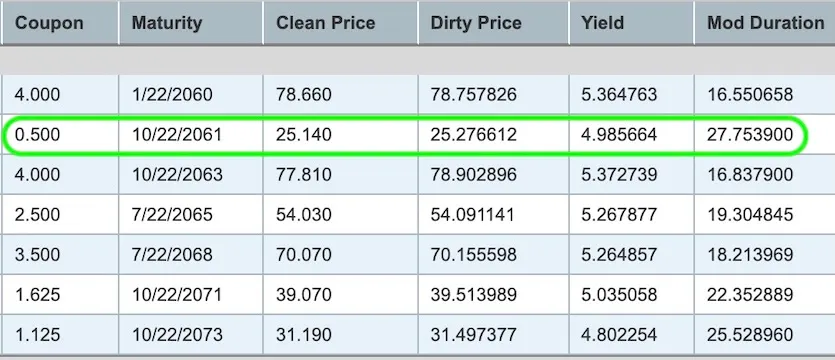
TG61 carries just a 0.5% coupon, i.e. annual interest rate, which is paid out to investors every 6 months. If held to maturity in 2061, investors would receive minimal income, however the capital gain would be substantial as the bond reverts to face value as it approaches its maturity. For bonds currently trading at roughly £25.50 per £100 nominal, as seen in the below table from TradeWeb, that accretion to par of £75 accounts for the majority of just under a 5% yield.
Whilst interest received from gilts is taxable income, the capital gains, by contrast are currently tax free – see this HMRC guidance for more detail (LGB does not offer tax advice, and official policy and law on taxation can change). High-rate taxpayers, therefore, often favour long-dated, low coupon gilts precisely for this advantage. The advantage does not apply for gilts held within ISAs or SIPPs.
The Anomaly in Plain Sight
Bonds maturing around the same date as TG61 trade at closely clustered yields. However, TG61 stands out from the other gilts surrounding it with its yield-to-maturity sitting nearly 40 basis points lower than adjacent long-dated gilts. This premium pricing likely reflects its more advantageous tax status. With a running yield (the incidence of the coupon on the current price) accounting for less than half the return, it is in a different position to its peer group.
Source: TradeWeb
The Risks and Opportunities: Duration, Volatility, and Patience
TG61 has exceptionally long duration – that is, not only does it have a long maturity, but the investor must wait longer to receive the majority of the return compared to a high coupon gilt with a similar maturity. This longer duration means the price of the bond will be more sensitive to changes in the wider interest rate environment. Just a one-percentage point interest rate fall (for relevant maturities, not the short-term interest rate) could move its price up by around 33%. A one percent increase would cut the price by circa 26%. This is not for the fainthearted investor. If you believe that the government’s budgetary problems will worsen, and that the bond vigilantes will penalise it in the market, then this is something to steer well clear of. If on the other hand you think that the market is over-discounting the problems, then there may be an opportunity here. If you consider that the main risk is inflation, then it may be worth looking at index-linked gilts which we will turn to in a future article.
Final Thoughts
Fixed income fund managers running evergreen portfolios must take into consideration the duration of bonds, as they will be required to buy and sell bonds to meet subscriptions and redemptions and keep the fund running. As a private investor, one can adopt a buy and hold strategy. This means that each bond is purchased and held until maturity. The benefit of this that any volatility of the bond prices during the life of the bond will not impact the investor’s return. Cash flows and returns are predictable once the bond has been purchased, as the investor simply waits to receive the coupon payments and the eventual repayment of the bond at par at maturity (subject to any credit risk). Trading fees are also kept low due to one-time purchases, rather than buying and selling.
This being said, long duration conventional bonds do not offer any protection against inflation, so if you are pessimistic on that front they should be avoided. If you would like to explore how long-duration gilts might complement your income portfolio or if you seek tailored fixed income strategies, we would be pleased to assist.

Transaction Manager
Alexia Rottet joined LGB in October 2025 as a Transaction Manager. Prior to LGB, she gained real estate experience by participating in the valuation of a property portfolio for A2immo.ch SA as a financial analyst, as well as working at Form Structural Design as an office manager. Alexia holds an MA in Entrepreneurship and Innovation and a BA in International Relations.

Assistant Relationship Manager
Ruby joined LGB in December 2024 as an Assistant Relationship Manager for our investing clients. Prior to LGB, Ruby worked at FHIRST, a start-up where she collaborated with the co-founders on revenue growth and improving client experiences. Ruby graduated with a First-Class degree in History from Durham University.

Finance Manager
Following a degree reading Chemistry at The Queen’s College, Oxford, Antonia trained to become a chartered accountant at a London-based audit firm. She then moved into the tax sector joining EY and completing the chartered tax adviser qualification. She then gained further experience working as a finance director within industry at a family office / hedge fund.
Programme size: £20m
Establishment Date: December 2017
Number of issues: 12
Sector: Marine tracking
Focus: Maritime surveillance and management
Programme size: £25m
Establishment Date: XX 2017
Number of issues: 20
Sector: Financial services
Focus: Loans and leasing

Associate Director
Omar joined LGB in February 2026 as an Associate Director in the Capital Markets team. He brings over five years of experience from NatWest, where he worked across the Leveraged Finance Origination and Portfolio Management teams. During this time, he supported a broad range of businesses from venture-backed to large-cap companies, with a primary focus on the mid-market. His experience was sector agnostic, and the majority of the companies he worked with were sponsor-backed, giving him extensive exposure to private equity-led transactions and capital structures. Omar holds a degree in Accounting and Finance from The London School of Economics & Political Science and is a Chartered Banker.
Adviser
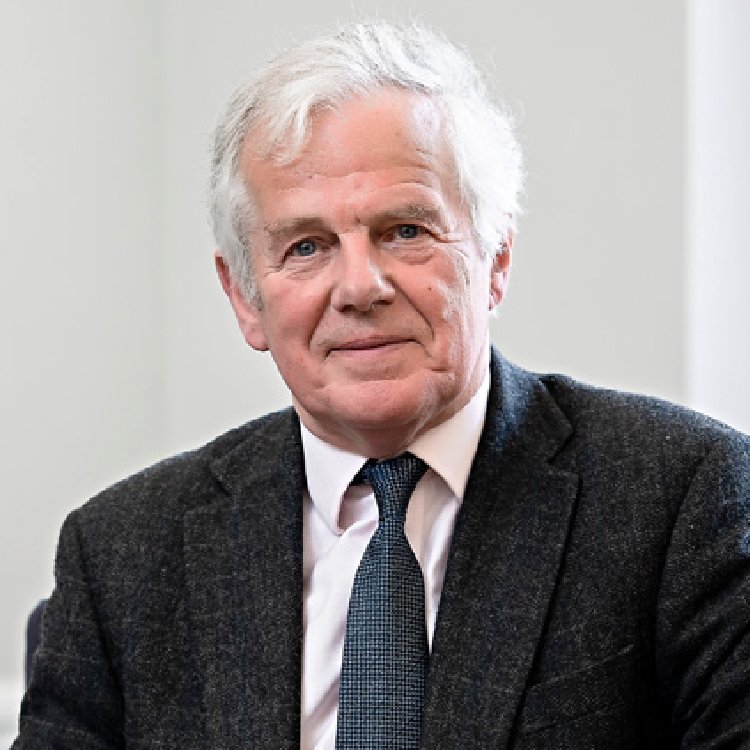
Charles has played an important role in developing LGB & Co.’s investment approach by encouraging a focus on investing in businesses with strong IP or know-how with recurring revenue business models that can prosper throughout economic cycles. Charles brings over 30 years’ experience of investing in privately-owned and publicly-listed small and mid-market companies. He is a director of Larpent Newton & Co. and Hygea VCT plc. Charles qualified as a Chartered Accountant at Peat Marwick, now part of KPMG.

Adviser
Lisa has worked with LGB since 2015 in supporting the on-going cultural and organisational development of the firm, providing advice on strategic people matters. Since 2006, Lisa has been running her own consultancy and executive coaching business, People Possibilities Ltd. Her work is focused on supporting clients at an organisational, team and individual level to enable high performance,improve leadership capability and effect cultural and behavioural change. Previously Lisa has held senior HR leadership positions with Schroders, ABN AMRO and HSBC. Lisa graduated from the University of Birmingham with an honours degree in International Relations & French. She is a Fellow of the Chartered Institute of Personnel and Development (CIPD) and a qualified Executive Coach.

Chairman
Simon became non-executive Chairman of the Board of LGB & Co. with a focus on growth and strategic initiatives in December 2025. Simon has extensive experience in capital markets and wealth management. He previously ran the client and investment business of Heartwood and became Chief Executive in 2008. He led its well-regarded acquisition by Handelsbanken in 2013. Simon subsequently became NED and Chair of AIM-listed WH Ireland Group PLC. He was also asked to represent the wealth management sector on the FCA Smaller Business Practitioner Panel from 2013-2016.

Capital Markets Director
Fergus advises corporate clients looking to raise debt and equity capital. He is also responsible for the execution and ongoing management of LGB’s MTN Programmes. Fergus joined LGB in 2019 having started his career at Lloyds Banking Group on the graduate training programme, before moving to the Leveraged Finance division, where he focused on transactions with mid-market corporates and PE firms. Fergus holds an MSc in Petroleum Geology from the University of Aberdeen.

Associate Director
Megan joined LGB in 2021 as a Relationship Manager. She is responsible for all day-to-day transactions with investment clients and oversees the LGB Investments Platform and Deal Hub. Prior to LGB, Megan worked at Puma Investments, a tax-efficient investment provider, in the sales and investor services team. Megan graduated from the University of Bath with a Bachelor of Science degree in Psychology, and has obtained the CISI Level 4 Diploma in Investment Advice.

Investment Director
Ivan is LGB’s Investment Director: he is responsible for developing LGB’s investment proposition in the context of the broader market and economic developments. He regularly meets individual company management teams to seek out and monitor investment opportunities. Ivan has served as a senior adviser to the Equity Division of Société Générale, and was previously Managing Director in charge of equity sales for them in London. Earlier in his career, Ivan worked at Morgan Stanley, Lazards and Schroders. He has degrees in history from Cambridge University & London University, and an MBA from Cass Business School.

Managing Director
Simone joined LGB in 2012 and is responsible for LGB & Co.’s business with institutional investors, wealth managers and sophisticated private investors. Simone’s team provides access to a range of compelling investment opportunities with a particular emphasis on structuring laddered portfolios of fixed income. In addition, the team manages portfolios of clients who have entered into advisory agreements with LGB Investments, and advises the fund managers of the Guernsey-based LGB SME Private Debt Fund. Prior to joining LGB & Co., Simone worked in the institutional fixed income department of Citigroup Global Markets. She began her career at Citigroup Private Bank in Geneva. Simone graduated from the University of Lausanne with a degree in HEC, Business Administration. She is a Chartered Member of the Chartered Institute for Securities & Investments and a Director of LGB.

CEO
Cedric was appointed CEO in July 2022 after a period of 18 months as a COO. Cedric spent 15 years working on the energy and commodities sales and trading desks for global banks (BNP Paribas, BAML and MUFG). He gained extensive international exposure, being based in London and Singapore and covering transactions in all geographic regions. Cedric graduated from Global Executive MBA at INSEAD in 2018 and started working in the capital markets space for growth-stage companies. He is also a director of LGB.

Managing Director, Capital Markets
Andrew founded LGB & Co. in 2005 and is managing the Capital Markets team. He has a particular focus on the development of strategic relationships with corporate clients and business partners. Prior to founding LGB & Co., Andrew was a Managing Director at Citigroup Global Markets, where he was responsible for its fixed-income business with private banks and retail institutions. Earlier in his career Andrew worked at Schroders in London and Tokyo. Andrew graduated from Oxford University with a degree in Modern History. He is a chartered member of the Chartered Institute for Securities & Investment.