


The latest cut in the UK bank rate to 4% has left it not far above the inflation rate (CPI was running at 3.6% in June) – for a 40% tax payer able to hypothetically get 4% on savings (it makes the calculation easy). The after-tax return of 2.4%, therefore, represents an implied negative real return on savings of 1.2% per year. While admittedly an unlikely outcome, if the Monetary Policy Committee’s projection that CPI will fall to 2.7% in a year is accurate then 4% would still imply a negative real return; and by that time and with that outcome the MPC would have cut rates further.
Cash is useful as a buffer. It is useful as a match for liabilities falling due soon, and it is useful to take advantage of future buying opportunities. Indeed, the senior partner of one fund management group – trying to calm his team in the face of a severe bout of market jitters – suggested that they make their way to Sotheby’s or Christie’s, and probably took advantage of the lack of bidders.
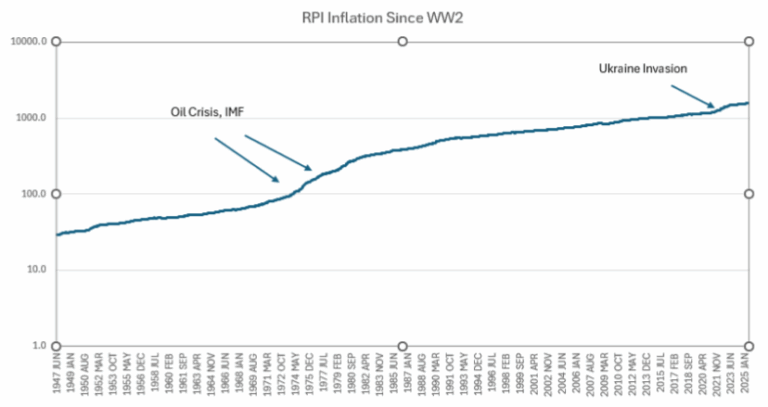
Inflation has been a permanent feature of the UK economy since WW2- it has broadly suited governments as it has eroded debts. The long term trajectory was a steady increase, with a period in the 1970s when it got out of control, and a recent acceleration around the Ukraine invasion: showing the RPI rate in log scale shows the rate of change:
There are, alas, reasons to fear that higher inflation is becoming embedded in the UK, and possibly in the West more generally. Jonathan Ruffer’s neat summary is that “globalisation lowered prices and thereby lowered inflation, and a return to local production reverses that dynamic”. Actually, globalisation has unleashed a long-term inflationary problem for countries with weak productivity as autarkic trading policies increase the prices of natural resources, strategic materials, and components in real terms for those countries decreasingly able to produce their own or pay for those coming from elsewhere. For example, the UK has: choked off hydrocarbon production without successfully tackling demand, reduced food production, failed to develop a domestic chip making capacity, and is driving the pharmaceutical industry offshore.
The UK’s perennial trade deficit is no longer so readily funded by inward investment as formerly. With high taxes and increasingly restrictive labour rules, the UK is not looking like an attractive place to invest. Sterling’s long-term depreciation seems likely to resume at some stage, importing price pressures. The inflationary situation is worsened by the paradox of a tight labour market with low unemployment, but a disproportionately high inactivity rate, loading costs onto those in work and keeping pressures on pay rates up.
Experienced Bank of England watchers, such as Andy Sentance (late of the MPC), have pointed out that the 7 August vote for a rate cut, unusually, and possibly uniquely, pitted the Governor of the Bank, Andrew Bailey, against his Chief Economist and his deputy, who both voted for no change. Their concerns included persistent inflationary pressures (presumably wages growing at 5%, services prices 4.7%, and inflation expectations in some quarters as high as 4%, must all have been in focus). The commentators’ deduction is that despite its mandate to maintain inflation at or below 2%, Bank policy has now shifted towards trying to boost growth despite the inflationary pressures, in order to take pressure off the Chancellor. There is no doubt that the Bank has succumbed to political pressure before – arguably when it kept rates low for far longer than necessary with QE. It seems to be happening again. Political pressures are also very evident in the USA where President Trump would clearly like to force the Fed into pursuing a low interest rate policy irrespective of inflation.
It can be useful to look at a concrete example. According to GiltsYield.com, if inflation runs at 2% a £100,000 lump sum invested in a laddered portfolio of conventional gilts will deliver to a 40% taxpayer an inflation-adjusted return of £5,784/year over a 20 year period (leaving nothing at the end). If inflation runs at 4% the return is £4,482/year, or 23% less. The risks are in the early years. A 2% overshoot in inflation at the beginning of the period reduces the value of the entire income stream, while a 2% overshoot at the end only the last year’s payment.
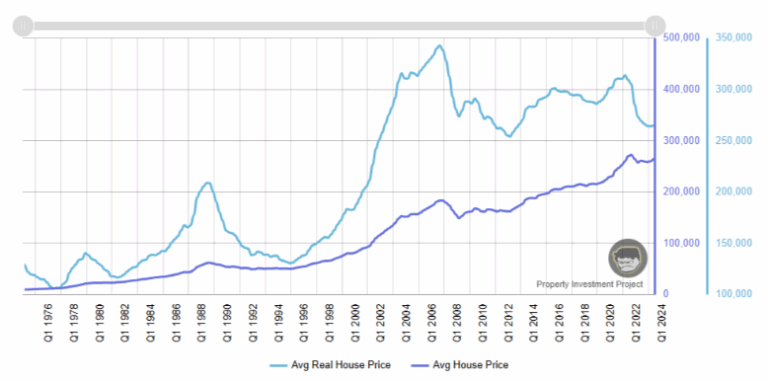
The conventional wisdom is that housing in the UK is an inflation-proof investment. But the evidence is that it isn’t so. The attached chart shows UK average house prices (from the Nationwide survey) vs RPI over 40 years to 2024:
The two sustained periods in which house prices outperformed inflation were the early years of the Thatcher administration, as income tax fell and domestic rates were removed, and under the Blair administration, though already peaking before the Global Financial Crisis. Through the last fifteen years, despite super-low interest rates and demographic pressures, there’s been no consistent trend. Housing is a complex market- London has its own dynamics, for example, currently unfavourable ones. Houses are an asset that can’t be moved offshore, and are an obvious target for a tax-hungry exchequer.
Over recent decades, and indeed over the long-term, equities have outpaced inflation. Long-term studies from Barclays and Cambridge Associates suggest real average compound returns for UK equities over rolling 50-year periods of between 2% and 8%, trending around 5%. Super-long periods may be useful for institutions and endowments, but less so for individuals – absent a fix for mortality. The early 1970s in the UK saw inflation, which was driven in part by the oil shock and exacerbated by domestic wage pressures, having a disastrous effect on the stock market. Inflation combined with economic stagnation (or stagflation) played havoc with corporate profitability as cost increases outran the ability of companies to pass on price increases, and they were simultaneously hit with higher interest rates.
The health warning “past performance is not indicative of future results” should always be born in mind. Still, equity selection with a focus on sectors with good pricing power, and on countries with good levels of underlying growth and improving terms of trade, should provide protection.
There are two bond markets which offer a liquid market in inflation-linked bonds – gilts and US Treasuries. Roughly a quarter of the gilts market comes in index-linked form, and there is an extensive choice of maturities, such that it is possible to build a laddered portfolio of “linkers”. The US treasury market is not so extensive relatively (under 10% of the market), though huge in absolute terms. The longest maturities issued are 30-year terms. There are some technical differences in the way they are priced but, as things stand, the major difference for a UK private investor is that the inflation-linked increase in the bond’s price over time is not (for now at least) subject to capital gains tax (the exemption, laid out in for example in this HMRC guidance note, does not of course apply to TIPS).
Real yields are calculated for “linkers”. These correspond to the inflation-adjusted return (and can be further adjusted for the anticipated tax on the coupon, albeit for most the coupon is relatively low).
Index-linked gilts are needlessly hard to deal in, due in part to the way they are priced. Both the principal and the interest are adjusted twice a year to take account of the change in the Retail Price Index. However, the nominal amount of the gilt does not change, instead the adjustment is treated like accrued interest, and is calculated as an additional charge. Except that is for two issues which do adjust(…just to make life more complicated). This can, in some cases, particularly with issues that have been outstanding for some years and have already accumulated a large inflation adjustment, be a multiple of the nominal amount. The 1.25% gilt issued in 2006 and maturing in November 2027 is quoted with a “clean” price of £101.65 – in addition (as with any gilt) you would pay the accrued interest of 49p – but also a large RPI adjustment that takes the dirty price up to £211.49!
As a further complication, linkers can be adversely affected by weakness in the conventional bond market – this was certainly the case in the period of the Truss/Kwarteng sell-off. All that said, if you want to hedge a longer term sterling liability, they are the only way to do it.
Having offered up a preliminary mixture of confusion, we shall be returning to the topic later in the year.
What is worth saying at this stage is that the logical use for these gilts is at the more distant end of a laddered portfolio. For maturities up to three years, we continue to suggest that LGB-sponsored MTNs should be an important part of your portfolio. At present, gilt yields in maturities up to five years are clustered below 4%. Beyond that, a mix of corporate bonds and conventional gilts yield in excess of 5% are available with a 14 year maturity. But, to protect the long term value of a portfolio, linkers come into play.
| Cookie | Duration | Description |
|---|---|---|
| cookielawinfo-checkbox-analytics | 11 months | This cookie is set by GDPR Cookie Consent plugin. The cookie is used to store the user consent for the cookies in the category "Analytics". |
| cookielawinfo-checkbox-functional | 11 months | The cookie is set by GDPR cookie consent to record the user consent for the cookies in the category "Functional". |
| cookielawinfo-checkbox-necessary | 11 months | This cookie is set by GDPR Cookie Consent plugin. The cookies is used to store the user consent for the cookies in the category "Necessary". |
| cookielawinfo-checkbox-others | 11 months | This cookie is set by GDPR Cookie Consent plugin. The cookie is used to store the user consent for the cookies in the category "Other. |
| cookielawinfo-checkbox-performance | 11 months | This cookie is set by GDPR Cookie Consent plugin. The cookie is used to store the user consent for the cookies in the category "Performance". |
| viewed_cookie_policy | 11 months | The cookie is set by the GDPR Cookie Consent plugin and is used to store whether or not user has consented to the use of cookies. It does not store any personal data. |
![]()
Transaction Manager
Alexia Rottet joined LGB in October 2025 as a Transaction Manager. Prior to LGB, she gained real estate experience by participating in the valuation of a property portfolio for A2immo.ch SA as a financial analyst, as well as working at Form Structural Design as an office manager. Alexia holds an MA in Entrepreneurship and Innovation and a BA in International Relations.

Assistant Relationship Manager
Ruby joined LGB in December 2024 as an Assistant Relationship Manager for our investing clients. Prior to LGB, Ruby worked at FHIRST, a start-up where she collaborated with the co-founders on revenue growth and improving client experiences. Ruby graduated with a First-Class degree in History from Durham University.

Finance Manager
Following a degree reading Chemistry at The Queen’s College, Oxford, Antonia trained to become a chartered accountant at a London-based audit firm. She then moved into the tax sector joining EY and completing the chartered tax adviser qualification. She then gained further experience working as a finance director within industry at a family office / hedge fund.
Programme size: £20m

Establishment Date: December 2017
Number of issues: 12
Sector: Marine tracking
Focus: Maritime surveillance and management
Programme size: £25m

Establishment Date: XX 2017
Number of issues: 20
Sector: Financial services
Focus: Loans and leasing

Associate Director
Omar joined LGB in February 2026 as an Associate Director in the Capital Markets team. He brings over five years of experience from NatWest, where he worked across the Leveraged Finance Origination and Portfolio Management teams. During this time, he supported a broad range of businesses from venture-backed to large-cap companies, with a primary focus on the mid-market. His experience was sector agnostic, and the majority of the companies he worked with were sponsor-backed, giving him extensive exposure to private equity-led transactions and capital structures. Omar holds a degree in Accounting and Finance from The London School of Economics & Political Science and is a Chartered Banker.

Adviser
Charles has played an important role in developing LGB & Co.’s investment approach by encouraging a focus on investing in businesses with strong IP or know-how with recurring revenue business models that can prosper throughout economic cycles. Charles brings over 30 years’ experience of investing in privately-owned and publicly-listed small and mid-market companies. He is a director of Larpent Newton & Co. and Hygea VCT plc. Charles qualified as a Chartered Accountant at Peat Marwick, now part of KPMG.

Adviser
Lisa has worked with LGB since 2015 in supporting the on-going cultural and organisational development of the firm, providing advice on strategic people matters. Since 2006, Lisa has been running her own consultancy and executive coaching business, People Possibilities Ltd. Her work is focused on supporting clients at an organisational, team and individual level to enable high performance,improve leadership capability and effect cultural and behavioural change. Previously Lisa has held senior HR leadership positions with Schroders, ABN AMRO and HSBC. Lisa graduated from the University of Birmingham with an honours degree in International Relations & French. She is a Fellow of the Chartered Institute of Personnel and Development (CIPD) and a qualified Executive Coach.

Chairman
Simon became non-executive Chairman of the Board of LGB & Co. with a focus on growth and strategic initiatives in December 2025. Simon has extensive experience in capital markets and wealth management. He previously ran the client and investment business of Heartwood and became Chief Executive in 2008. He led its well-regarded acquisition by Handelsbanken in 2013. Simon subsequently became NED and Chair of AIM-listed WH Ireland Group PLC. He was also asked to represent the wealth management sector on the FCA Smaller Business Practitioner Panel from 2013-2016.

Capital Markets Director
Fergus advises corporate clients looking to raise debt and equity capital. He is also responsible for the execution and ongoing management of LGB’s MTN Programmes. Fergus joined LGB in 2019 having started his career at Lloyds Banking Group on the graduate training programme, before moving to the Leveraged Finance division, where he focused on transactions with mid-market corporates and PE firms. Fergus holds an MSc in Petroleum Geology from the University of Aberdeen.

Associate Director
Megan joined LGB in 2021 as a Relationship Manager. She is responsible for all day-to-day transactions with investment clients and oversees the LGB Investments Platform and Deal Hub. Prior to LGB, Megan worked at Puma Investments, a tax-efficient investment provider, in the sales and investor services team. Megan graduated from the University of Bath with a Bachelor of Science degree in Psychology, and has obtained the CISI Level 4 Diploma in Investment Advice.

Investment Director
Ivan is LGB’s Investment Director: he is responsible for developing LGB’s investment proposition in the context of the broader market and economic developments. He regularly meets individual company management teams to seek out and monitor investment opportunities. Ivan has served as a senior adviser to the Equity Division of Société Générale, and was previously Managing Director in charge of equity sales for them in London. Earlier in his career, Ivan worked at Morgan Stanley, Lazards and Schroders. He has degrees in history from Cambridge University & London University, and an MBA from Cass Business School.

Managing Director
Simone joined LGB in 2012 and is responsible for LGB & Co.’s business with institutional investors, wealth managers and sophisticated private investors. Simone’s team provides access to a range of compelling investment opportunities with a particular emphasis on structuring laddered portfolios of fixed income. In addition, the team manages portfolios of clients who have entered into advisory agreements with LGB Investments, and advises the fund managers of the Guernsey-based LGB SME Private Debt Fund. Prior to joining LGB & Co., Simone worked in the institutional fixed income department of Citigroup Global Markets. She began her career at Citigroup Private Bank in Geneva. Simone graduated from the University of Lausanne with a degree in HEC, Business Administration. She is a Chartered Member of the Chartered Institute for Securities & Investments and a Director of LGB.

CEO
Cedric was appointed CEO in July 2022 after a period of 18 months as a COO. Cedric spent 15 years working on the energy and commodities sales and trading desks for global banks (BNP Paribas, BAML and MUFG). He gained extensive international exposure, being based in London and Singapore and covering transactions in all geographic regions. Cedric graduated from Global Executive MBA at INSEAD in 2018 and started working in the capital markets space for growth-stage companies. He is also a director of LGB.

Managing Director, Capital Markets
Andrew founded LGB & Co. in 2005 and is managing the Capital Markets team. He has a particular focus on the development of strategic relationships with corporate clients and business partners. Prior to founding LGB & Co., Andrew was a Managing Director at Citigroup Global Markets, where he was responsible for its fixed-income business with private banks and retail institutions. Earlier in his career Andrew worked at Schroders in London and Tokyo. Andrew graduated from Oxford University with a degree in Modern History. He is a chartered member of the Chartered Institute for Securities & Investment.